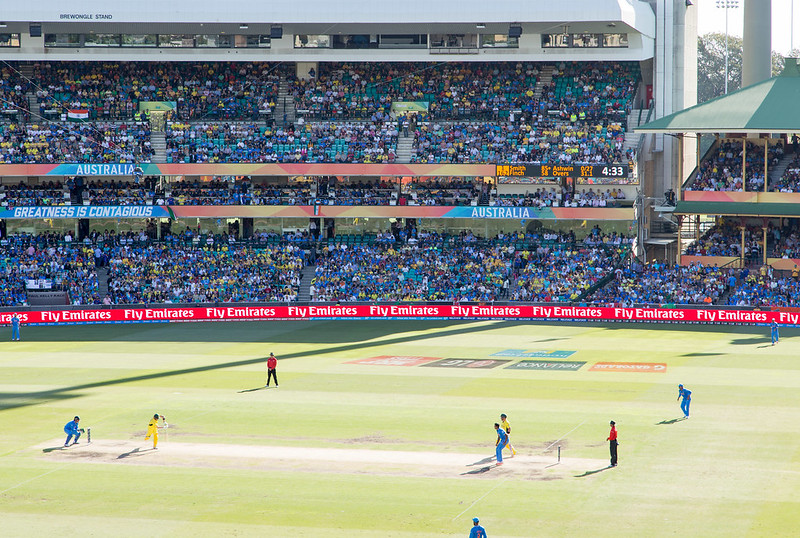
With a certain amount of separation from the World Cup (or at least enough for most nations to begin more bilateral series’) and the Anglo-Aussie cricket-sphere in the midst of a racism-sexism-you-name-it-ism horror show, it seems like a good time to look back on a very weird tournament.
The 2020 World T20 (there has to be a better title) was a tournament of extremes, with many games feeling close, but ultimately not actually being close. Several teams were shown up by their underuse of analytics, whilst others (one most notably) basically saying ‘up yours, nerds’ and disregarding more complex match-ups in favour of ‘giving it a whack’.
Take England for example.
In their semi-final loss to New Zealand, plenty of blame can be attributed to Chris Jordan and Chris Woakes who bowled some absolute dross to Jimmy Neesham and Darryl Mitchell. To lay the blame solely at their feet however would be missing the point slightly.
During England’s innings there was a definite edginess to their approach, probably leaving them 10 or so runs short. Jos Buttler was not able to find any fluency at the top of the order, and Jonny Bairstow has looked completely out of touch throughout. Dawid Malan, for once was not the subject of most England fans’ ire as he and Moeen Ali rebuilt fairly competently but failed to completely seize the initiative, like many teams in the first innings in this competition.
England then bowled brilliantly in the powerplay, with New Zealand going absolutely nowhere, a state they remained in (albeit with wickets in hand) until the 16th over. Jordan was to bowl the over, to Neesham. Conventional cricketing wisdom (now there’s an unlikely collection of words) dictates that, in crunch moments, a fast bowler would revert to bowling yorkers.
Bowl the ball hard and fast at the toes of the batter, and attempt to hit the base of the stumps.
This has been proven in recent years to be a high risk strategy with almost no margin for error. Batters are now better able to set themselves, standing deep in their crease to meet the ball on the half-volley.
The most successful death bowlers at the moment are people like Kagiso Rabada, Tymal Mills and Jasprit Bumrah, who eschew this philosophy for a more balanced one. They tend to bowl a mixture (including some yorkers, with the element of surprise) and bowl a mix of both quicker and slower deliveries at all sorts of lengths.
Jordan had so far been very successful early in an innings, bowling ‘heavy’ deliveries into the pitch and making batters mistime shots, yet continued to try and hit his death overs yorkers. In the process he missed almost every attempt and Jimmy Neesham took full advantage. Mitchell Starc had similar luck in both the final and semi-final, with Kane Williamson and Fakhar Zaman in particular taking his full deliveries down with relative ease.
Contemplative batting and predictable ‘old fashioned’ death bowling were the undoing of several sides during this tournament, which is a victory for modern analysis.
Less so however, was the way that Australia strolled in, abandoning their pre-tournament bowler-heavy philosophy, for a muscular ‘win the toss, wing it with the fifth bowler, whack it in the last 10’ kind of plan, and won the thing.
If anybody, pre-tournament, had suggested that Australia would be anywhere near the trophy, using any cricket based reasoning then they would reasonably have been laughed out of the UAE.
The Australian line up instead took the shape of four strong bowlers, three average bowlers to make up the last four overs, and a strong, simple top seven.
Match-ups have become a huge part of T20 cricket recently, the most effective proof of this would be Moeen Ali’s use throughout the tournament. Since Moeen spins the ball away from the left-hander, he has been a valuable asset for England against top orders with plenty of southpaw options. Against Australia in the group stage however, Moeen was not used at all, due to Aaron Finch’s prowess at hitting off-spin. Instead, Adil Rashid was used against the Australian middle order, turning the ball away.
Australia opted for possibly the simplest match up imaginable, and it worked. Four of the Australian top seven open regularly for their domestic sides and much prefer facing pace, than spin. Aaron Finch and David Warner are two of the greatest T20 batters of all time so weren’t to be dislodged. Matthew Wade and Marcus Stoinis open the batting for the Hobart Hurricanes and the Melbourne Stars respectively, so eyebrows were raised when they continually featured at six and seven in this competition.
The decision paid off. Big time.
Since Wade and Stoinis are comfortable against high pace but not spin bowling, and they couldn’t open, it actually makes perfect sense to have them bat at the end of the innings, where they are unlikely to face spin. It’s a high risk strategy to place the onus of finishing an innings on two people who are used to starting one, but with Wade dominating Shaheen Afridi and hitting 41 from 17 deliveries to launch Australia into the final, you’d have to say it paid off.
Annoyingly, the emerging pattern of, bowl first, let opposition get decent total, struggle early, cash in later and win, became almost the rule of the tournament, leading to the team winning the toss, almost always winning the match.
Whilst the predictability of it became tiresome, seeing the two favourites and stand-out sides of the competition fall foul of the formula, did still show how knockout tournaments are like no other form of sport.
I cannot find it within myself to see Australia winning the tournament as a good thing, but it has to be said that it is refreshing when the non-favourites overperform.
Fear not, if you feel that there is already too much cricket going on and your team underperformed, rest easy in knowing that the next World Cup is not for another, oh, one year…
 Michael Vince on Sport
Yes safe to say that this year’s 2022 T20 World Cup in Australia will have plenty of hype riding around it with bigger crowds, bigger atmosphere, greener pitches will mean bigger scores in excess of 190. Will favour the Indian, Australian and English sides, however will be tough for the likes of Pakistan and New Zealand. But having said that, Pakistan have revolutionised their T20 approach last year in 2021 and seem to be an explosive side now so maybe can contend on the fast Australian pitches. I also wrote an article recently on Pakistan’s transformation in T20 cricket, have a read… https://aheadofthesport.wordpress.com/2021/12/19/how-pakistan-defied-their-t20-stereotypes-in-2021/#more-1703
LikeLike