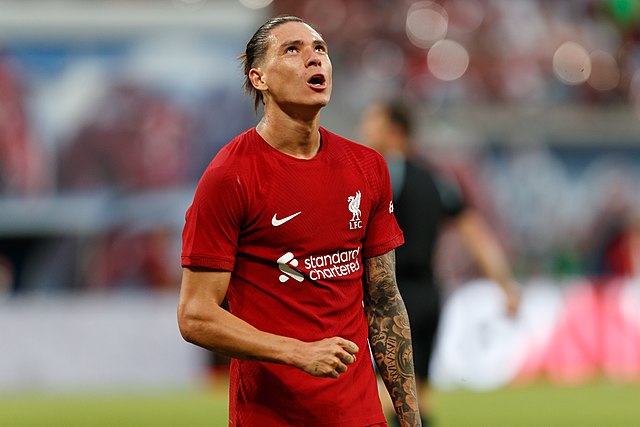
While Manchester United were busy drunk-dialling Marko Arnautović in the search for their 417th (rough estimate) stop-gap striker since 2014, their much more successful blue cousins were celebrating the debut of a striker of their own.
Both Liverpool and City made moves in the transfer window which should quite frankly terrify some of the other teams in the league. While United’s backroom meetings probably go something along the lines of:
Erik ten Hag: Hey guys, hope you’re all well, honoured to be named the new Manchester United manager, really glad you bought into my rebuild plan. As you know I have an extensive knowledge of the Eredivisie in particular and am hoping that with a three year plan and investment in youth and scouting I c-
Board: Let me stop you right there, we’ve already identified some top talent in the forward area who we think could fit right in for when Cristiano can’t be bothered.
Erik ten Hag: Great! I imagine the likes of Jonathan David, Patrick Schick and Gianluca Scamacca have popped up on your radar? Players that we could get for slightly less than they are worth due to the markets that they play in?
Board: Even better! We’ve noticed that Edin Dzeko could be easier to pry away from Inter Milan now Lukaku has re-signed, and Inter Miami have given us what we believe to be a very sensible valuation of £76 million for Gonzalo Higuaín. Which do you fancy?
Erik ten Hag: …
Manchester City announced probably football’s worst kept secret this year in signing Erling Haaland from Borussia Dortmund, and Liverpool splashed the cash on Benfica’s Darwin Núñez.
Both of these signings are signals of intent from the two already dominant forces in the English game. It has been widely discussed how teams are moving away from traditional team structures with a ‘number 9’ or central attacking focal point. and both Liverpool and City were at the forefront of this, often operating without a single recognised number nine in their squad after Sergio Aguero’s departure.
This move then, coupled with the arrival of players such as Scamacca to the Premier League, perhaps signals another evolution (genuinely no pun intended) of the position moving forward.
So why are Darwin and Haaland so dangerous?
The short answer, which unfortunately media outlets can’t get away with publishing, but tells you all you need to know, is that Liverpool have signed a pacey, hard, dogged Uruguayan (sound familiar?) and City have signed a six-foot-four freak of nature who looks and plays like he was created in a test-tube to score goals.
To make a slightly more interesting article (subjective, I understand) it wouldn’t hurt to see why these two players are so good and what makes them fit in so nicely at their respective new homes.
Firstly, Erling Haaland has been on the tip of everyone in football’s tongues when thinking of those young players at the forefront of European football in recent years. The gigantic Norweigan is the son of former Leeds and City man Alfe-Inge Haaland, and has been tearing up domestic leagues at every level since becoming a full professional, but we already know this, what makes him likely to succeed in the Premier League?
With the obvious aspects first, Haaland is absolutely massive, not Athletic level analysis there but it’s pretty relevant when considering his success at his current level.
People do like to drone on about the physicality and pace of the English game but unfortunately they are correct. It’s why so many forwards from the Spanish La Liga for example seem slightly out of their depth here. It has nothing to do with quality, but they are often not suited to the play style of English football.
If physicality and speed are two principle factors for success in England, then Haaland is already there. He is around six-foot-four or five depending on which corner of the internet you ask, and he was clocked at around 36 kmph in 2021, the fastest sprint in the Bundesliga that season.
It is not hard to see what he offers from that standpoint, but what can he offer Manchester City specifically?
It has become almost a running joke to talk about how City can secure a top two spot basically before the season starts but also play essentially a revolving system of 6 creative midfielders at any one time, each of whom seem to take it in turns to go on scoring runs, it was De Bruyne last year, and bizarrely Gundogan before that.
So the general consensus was that Haaland was brought in to win the Champion’s League. At times City have been a little flat in the key knockout games in late stages, with no outlet for when their slick passing patterns and triangles don’t work out.
Whilst it is incredibly harsh to reduce someone of this quality to a channel workhorse, can you imagine anybody better when you are in a tight fix and need an outlet to make a perfectly timed run onto a long pass?
Probably preferable to hoofing the ball at Bernardo Silva or Phil Foden anyway.
Not only is Haaland huge and rapid, he is incredibly intelligent on the pitch, timing his runs to perfection, something that is key when playing in such a well oiled unit as Pep’s ludicrously drilled side.
The best illustration of how Haaland can be world-beating at City, is how his favourite type of finish, is one that City have cultivated over the last few seasons, one referred to as the five-a-side goal, quick short passing followed by a neat close range finish.
No doubt Twitter will enjoy dubbing him as a ‘tap-in merchant’ due to this but it really is scary how his world-class movement will enable him to find space in the six-yard box to be picked out by any one of City’s painstakingly crafted attacking midfield combinations.
Oh, he can also strike the ball like this….
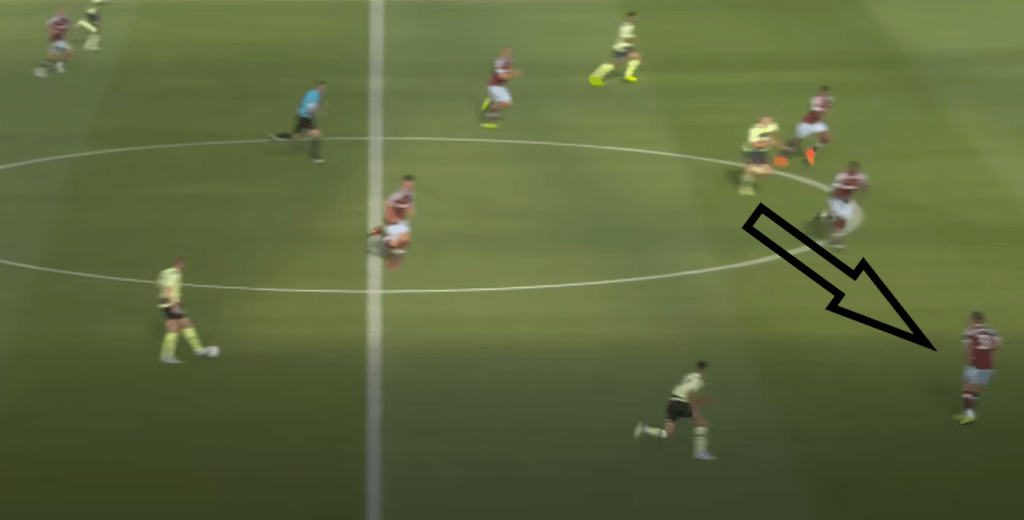
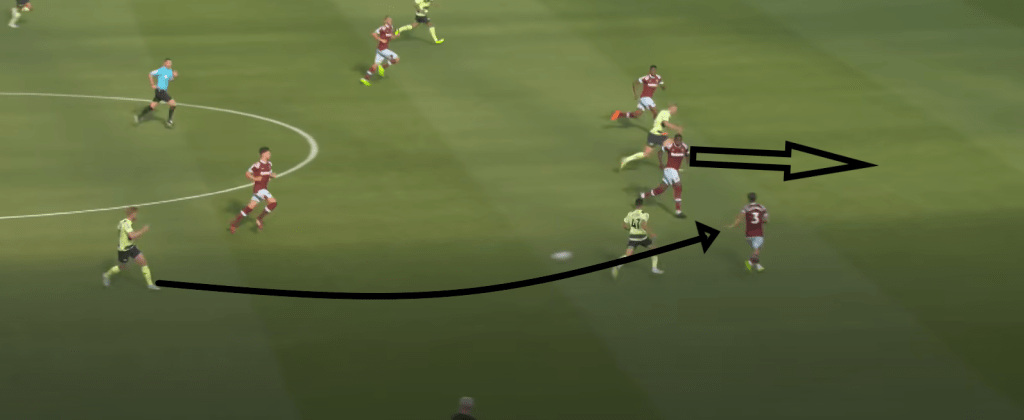
Against West Ham, Haaland’s second goal came via another classic route, with a trademark bending/zigzagging run across and then in-behind the defence, fed by Kevin de Bruyne.
Fans of rival clubs must be wondering how many times they will see this frankly depressing sight and know for sure that their side is about to be unpicked again:
To use some stats nerdery, over the last four seasons, Haaland has scored 64 goals from a total of 51 expected goals, pretty good.
Now, often players who overperform their expected goals in other leagues, generally tend to find that they underperform or experience a drop off in England.
With Haaland, you can almost guarantee that his expected goals per 90 minutes played will increase, with City having a higher quality difference over the rest of the league than Dortmund had in the Bundesliga.
This means that even if Haaland’s xg difference drops a bit, you can expect his output to stay the same, if not improve, which is quite frankly a terrifying thought.
Finally, City play United soon and (I’m sure no one has mentioned this before) there is a tiny bit of history there for Haaland junior, watch from a safe distance United fans.
Darwin Núñez presents a different prospect to Haaland but a not entirely less worrying one for rival clubs in the ensuing years.
Darwin’s profile and previous success marks him out as less of a nailed-on Premier League legend than Haaland but he still should pull up a few trees and offer Liverpool something different.
Whilst having a similar physical profile to Haaland and being able to make similar runs in behind, Darwin is much more of a Swiss-army-knife, something that Jurgen Klopp will value very highly while taking his forward line into a future without Sadio Mané and with a slightly-past-it-at-the-highest-level Roberto Firmino.
Darwin can play ostensibly anywhere across an attacking line-up. Operating best as a focal point through the middle or coming off the left-flank, he uses his size and power to create chaos in defensive lines.
The first indicator for a player’s success should probably be, is Jurgen Klopp willing to splash millions for them?
Liverpool under Klopp spent 65 mil (roughly) on Alisson and he is now one of the top five keepers in the world, and they spent 75 million on Virgil Van Dijk who is probably the best defender I can really remember seeing.
This is not to say that Darwin will go on to become a Premier League great, but the odds are more stacked in this direction than the alternative in my view.
Liverpool rely on a very dynamic front three, a lineup that is more or less interchangeable, and with Darwin’s ability to play central, giving more of a target-man or physical outlet than Liverpool have seen since Suarez’s departure, and his ability to play on the left, give Klopp real options.
At times Darwin can appear a little clumsy when dribbling in tight areas, but with space to run into and get physical with defenders, he is nigh on unstoppable.
This allows for tactical fluidity up front for Liverpool, with their strongest front-three looking like (from left to right) Luis Díaz, Darwin, Mo Salah. Should Díaz encounter a strong one-on-one fullback in the mould of Kyle Walker or Aaron Wan-Bissaka (yes he is actually quite good there) then Liverpool have the option of switching him inside with Darwin. This gives the fullback a different challenge, with a six-foot-two powerhouse giving a more physical battle, in turn giving the centre backs an entirely different prospect with Díaz moving more central.
Darwin is much less of a finished product than Haaland, and is less ruthless in front of goal at *this* juncture, but can terrorise defences nonetheless.
Liverpool have been electric in recent seasons, scoring freely all-season-long, but Darwin adds yet another angle of attack for Klopp, and adds some size and physicality which could be said to be their only minor weakness.
The Uruguayan had a ridiculous goalscoring season last term, with 32 goals across the Portuguese Primeira Liga and the Champion’s League, but can probably still improve his ruthless streak even further.
Haaland and Darwin are both obscene talents who have not yet hit the heights they can reach in their careers, both signed by the top two teams in England and probably Europe, two sides with clear plans going forward.
If this does not frighten the elites of European football senseless, then it should.
 Michael Vince on Sport