The English ODI side has been the best side in the world, by ranking, and by merit, since its re-modelling post 2015 World Cup. The batting order contains some of the most feared ball-strikers in the history of cricket. Joe Root still averages over 50 in the format, Jos Buttler has played some of the most outrageous innings of all time, and Jonny Bairstow is bettered maybe only by Rohit Sharma among openers.
The astonishing thing about this side is that alongside these three, Jason Roy averages over 40 with the bat, striking at over a run a ball, as does Ben Stokes. Eoin Morgan is one of the greatest captains the game has seen this decade, who averages close to 40, and Moeen Ali has three ODI centuries to his name.
As with any great side, there are players that miss out on much international honour, who would walk into other sides. Stuart Law scored over 27,000 First-Class runs at over 50, but could not break into the Australian side of the late nineties and early noughties. Wayne Daniel and Sylvester Clarke gave county batters nightmares for years but between them they won just 21 Test caps for the great West Indies sides of the early 80’s.
So here are some top-class batters who could not break into the most fearsome unit of all time.
- Dawid Malan
Malan has had success in the longest and shortest forms of the game internationally, breaking into the T20 side and reaching number one amongst male batters. He also showed his skills on fast, bouncy wickets by being the stand out English batter in the 2017/18 Ashes. No matter whether or not you believe him to be the correct man for the current T20 side, it cannot be disputed that he would be the perfect number three for a more circumspect team. An average of 41 and a strike rate rising towards the mid eighties in list A cricket proves that Dawid Malan would be a very worthy opener in any other era of English cricket. In fact, on the occasions that he has been asked to fill in, he has acquitted himself perfectly well, with a half century and an unbroken innings taking his average to 45 from three games. Malan’s ability to build an innings and explode when set can be lethal with 30 more overs than he is used to internationally.
2. James Vince
If Malan is prolific but not as quick as the incumbent pairing, then Vince can claim to be more prolific and as destructive as many current England players. An average of over 40 in Domestic List A matches with 3 scores over 170, marks Vince down as truly unlucky to be playing in such an era. People will no doubt point to his moderate-to-average record internationally but can they honestly say that he has had anything approaching a solid run of games in his best format? Vince plays shots that would not look out of place in a technical handbook, but the difference here is that he can hit textbook drives and pulls that most players would dream of, but send them miles over the ropes.

His score of 171 in the 2018 Royal London Cup semi-final is the best innings that I have personally seen live and you would have to go pretty far to see something better. In terms of pure numbers, Vince actually did manage to go for more, scoring 190 against Glamorgan, albeit a weaker attack in the group stage. Vince has never really been given the chance his ability merits, due to no fault of selection, he is just desperately unlucky to be one of the best domestic List-A players in the world, in the same era as Bairstow, Root and Roy.
3. Sam Hain
If I were Sam Hain (I have walked past him in Selly Oak retail park so I’m close) I would be fairly upset at the continued existence of Joe Root in the ODI side. Hain is a classy batter who anchors Warwickshire in both shorter formats. When in the mood Hain can appear completely unperturbed by early loss of wickets, building to a perfectly timed destructive crescendo in the closing overs. His 161* with virtually no support, against Worcestershire is one of the most masterful recent examples of strike retention and late ball-striking. His List-A average of 59.78 is still the highest of all time, with some separation from Michael Bevan and Virat Kohli. Hain has an advantage over most on this list in that he is still just 25 so he will almost certainly (surely?) get his chance in the future.
4. Daniel Bell-Drummond
Bell-Drummond still has one of the best limited overs records around in the UK currently, with his average sitting at over 42, despite his First-Class record taking a hit in recent years. Along with all mentioned in this top six, Bell-Drummond has had great success with the England Lions and with Kent but this has not seen him gain higher honours. In a different set-up Bell-Drummond’s leadership capabilities could see him anchor the middle overs and captain the side. With an initiative launched from his idea to get cricket back into state schools, and to increase participation and outreach to kids of Caribbean descent, Bell-Drummond has already made a sizeable contribution to English cricket.
5. Ben Duckett
Ben Duckett certainly made the most of the opportunity he was offered in 2016, with his only three ODI’s coming during England’s 2016 tour of Bangladesh. Duckett scored half centuries in two of these games, but due to the strength of the players to return to the side following the tour, has not played since. He has proven to be at various points one of the most aggressive and inventive players playing in the English domestic game today, with a strike rate just a notch under 100 in List-A cricket. Due to his smaller stature, Duckett has had to make use of his considerable talent in other ways, his reverse-sweeps and ramp shots have helped him towards successful T20 campaigns with both Northamptonshire and Nottinghamshire.
6. Sam Billings
Billings is the most proven international player on this list, even if he does more or less serve as the perfect utility man for English squads. Billings saw his huge talent finally pay off with an international century last year against the touring Australians and batting him at six is a bit of a waste but he also may be the most capable finisher here apart from our number 7. With the ability to bat basically anywhere in the top 7, Billings is also a fantastic wicket-keeper and a top player of spin, making him the first port of call should England lose a batter. A solid international record and a fantastic domestic record (ave 42 – s/r 104) with enough of a sample size behind him, suggests that a decent run in the team could reap the benefits of his immense talent.
7. Riki Wessels
The thing keeping this side back might be the more circumspect nature of some of the top four, although its not really an issue due to the sheer number of runs in the side and Vince and Billings’ ability to up the rate even more. The reliable nature of much of the top order means that there is some creative license to be had at number seven. When Riki Wessels gained British citizenship in 2016 he was not far from the selectors’ thoughts should Alex Hales and Jason Roy fail to set the world alight. By 2016 neither had done so, but during this year, both rose to the heights that they would then maintain for a number of series from then onwards. This was unfortunate for Wessels as he has always been marked as one of the most destructive batters around the county set up. With a fairly unspectacular average which has fallen to just over 30 in recent years, Wessels has still maintained a high strike rate (over 100) and could do the job as a finisher in this line-up.
All seven batters listed here will consider themselves extremely unlucky to star in the most dominant era of English limited overs batting that we have seen. Of course this top seven is impractical due to its lack of bowling options, Bell-Drummond and Vince would have to shoulder more overs than is preferable, but with the runs on the board this team guarantees, you never know.
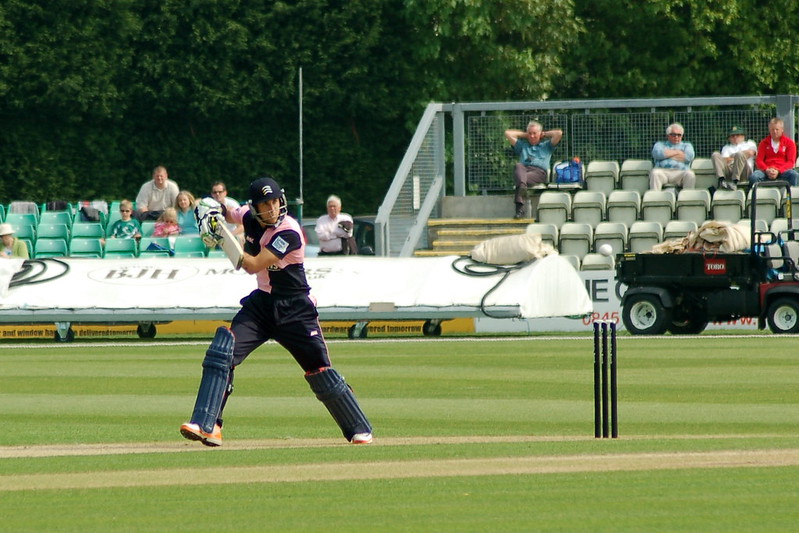
Photo credit: Paul SH on flickr, creative commons 2.0 https://creativecommons.org/licenses/by-nc-nd/2.0/legalcode
 Michael Vince on Sport